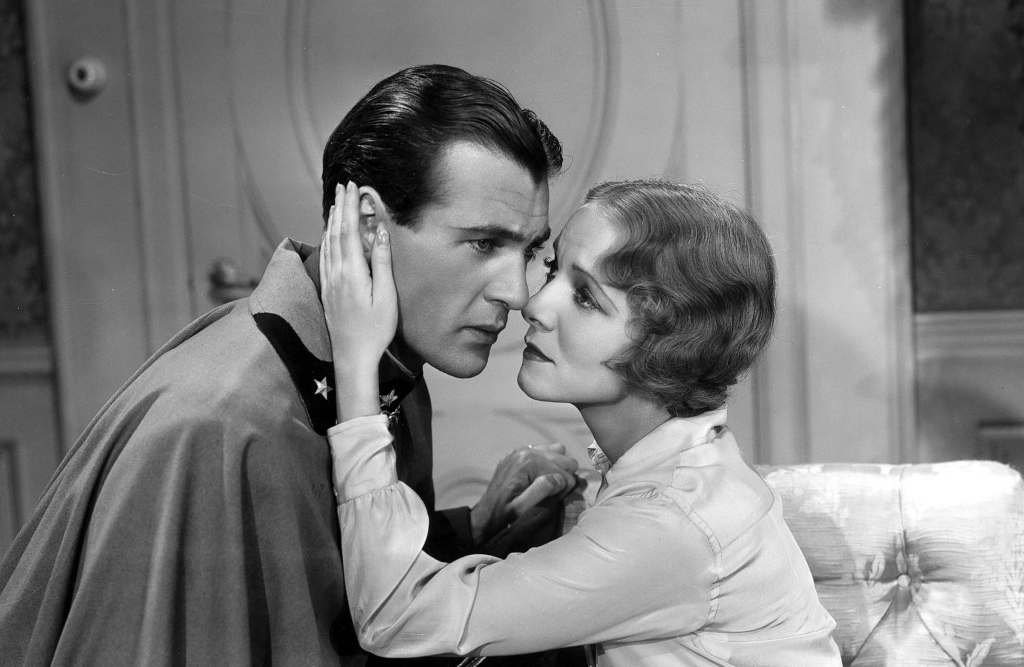
As one of the most successful authors of the twentieth century, Ernest Hemingway was no stranger to adaptations of his novels. The first book of his ever rewritten for the screen was A Farewell to Arms. It made its debut in 1932, directed by Frank Borzage. Given the awards it received, it stands as a decent film on its own. However, the adaptation itself fails to convey the true intention of Hemingway’s novel.
The introduction of the movie accurately reflects the trucks climbing uphill, but the similarities end there. The trucks do not “splash mud” on the road, nor does rain pour from the sky–a common indication of death in Hemingway’s novels (4). Instead, the movie begins quite tame. The trucks kick dust into the streets instead, a sleeping Frederic Henry in the passenger seat. Despite his role as an ambulance driver in the novel, it’s unclear from the imagery in the movie what his responsibility is. The movie only establishes his duty to make sure the injured are taken care of–but even that he does a poor job of. When he enters the hospital to indicate to an officer there are hurt soldiers outside, he shows no sign of urgency. He even takes his time to brush his hand on the waist of a nurse he’s never met. He spends a significant amount of time lingering around nurses doing their jobs. It quietly downplays the realness of the situation at hand. It’s the opposite of why Hemingway is so renowned as an author for his details of World War I.
Lieutenant Rinaldi is introduced shortly thereafter with his bold, mischievous characterization akin to the original. When he and Henry are reunited in the novel, he asks Henry, “Did you have any beautiful adventures?” (Hemingway 10). It is his way of asking Henry about the women he slept with. It was an effective way to set up Henry’s role as a “womanizer.” Though, this is not well elucidated in the movie. The dynamic between the two of them also falls flat. Though jovial to see him again, Henry seems much warier of Rinaldi than true to his character. In the book, Henry considers them to be “great friends” (Hemingway 11). Thus, when requested fifty lire by Rinaldi in the novel, he asks no questions. He just instinctually gives him the money, portraying that “war brother” bond and a knowingness of what Rinaldi intends to do with it.
The plot deviates greatly from that point forward. Henry and Rinaldi go out drinking, and Henry chats with a giggly Italian woman. It’s clear just how drunk Henry is. Then, a sudden airstrike occurs. Taking cover, he ends up in a small space with none other than the love interest of the story, Catherine. In his drunken state, he acts very strangely toward her, mistaking her for the Italian woman from earlier. He grasps her foot while monologuing about her “arch” and “architecture.” After they finish camping out, Catherine is asked by another nurse who “that man” is. “Oh, I don’t know. Some lunatic,” she responds. Henry had made a remarkably poor first impression.
This meeting between Henry and Catherine is a stark contrast to the novel. Their first conversation in the original is quite a vulnerable moment. Catherine confides in Henry about love and loss. He’s a man she’s only just met, and it shows her willingness to open herself up to someone so suddenly and so desperately.
The movie attempts to replicate this scene after a pre-established introduction to each other. They meet again at a party, leaving to sit in the garden where Catherine talks about her past. However, they do not discuss their thoughts about the war like Catherine and Henry do in the novel. Instead, they walk in silence to sit in a secluded area under the stars. It is clear there is no focus on the war in the movie’s adaptation. It is simply there, not a limiting factor. It is then that Henry insists they sleep together now rather than prolong anything. He takes her virginity, Catherine sobbing and laughing in the aftermath. “If you knew how I was back home, you’d see the funny side of it,” she says. It’s the most prospective part of the entire film thus far, actually acknowledging the change war and loss have had on her. Henry follows with an uncharacteristic “I love you.” In the novel, this is far from reality. Rather, a disillusioned Catherine asks him if he loves her, to which he lies.
It’s evident that his feelings develop far quicker for her in the movie than they do in the original, especially when he meets her to say goodbye before going to war. “I’d hate to have you feel that it wasn’t important to me, about- about us,” he says. In the book, Henry is not nearly as impassioned. Instead, he answers Catherine with short sentences, and he settles for a “Good-by” (Hemingway 37). In the film, Henry’s quickly bloomed feelings seem to be a plot device for the sake of romance, as opposed to detailing the complexities of a woman who desires the idea of love, and a man who sleeps around claiming to never have loved.
Deployed, Henry sits with soldiers around candlelight. In the book, they discuss the war and Henry asserts that “defeat is worse” than war (Hemingway 43). However, the film shys away yet again from commenting on the reality they’re facing. When the sound of a bomb dropping interrupts the soldier’s talking and eating, the terror of the moment is overlooked in a montage of smoke and dust. The screaming of Passini, like in the novel, isn’t heard. In fact, his death is not mentioned at all. Instead, it transitions into a man listing the various injuries of Henry–including his legs and a potentially fractured skull. It neglects the darkness of it all, the way the dead lay “off to one side” while doctors’ sleeves were as “red as butchers” (Hemingway 49). Instead, the movie centralizes the moment around Henry and Henry alone.
Henry and Catherine are reunited after Rinaldi intentionally arranges for Henry to be sent to Milan where Catherine is working. In the book, he only goes to Milan because they have better x-ray facilities. It’s the moment in the book that Henry really faces his feelings for her. “When I saw her, I was in love with her” (Hemingway 80). Similarly, he mutters “you’re lovely” repeatedly when Catherine enters the room in the film. However, later, something unusual happens. The priest unofficially marries them while Catherine is at Henry’s bedside. Catherine is willing to ignore the fact there are no “church bells” or “orange blossoms.” It is a great juxtaposition to her feelings about marriage in the novel. Both out of fear she would be sent away and they would be separated as well as her desire to be thin in her wedding dress, she refused to marry Henry.
The movie adaptation skips any drama regarding Henry’s wait for surgery on his legs. Instead, he is up and has to leave again quite soon. During one of the last times they see each other before he leaves, they kiss each other in the street surrounded by many people. It directly undermines the same fear Catherine in the original expressed when not wanting to get married. For example, in chapter twenty-three, they notice a couple publicly displaying their affection and “standing tight up against the stone” (Hemingway 129). “They’re like us,” Henry says. Catherine responds, “Nobody is like us.” Hemingway makes the distinction that she “did not mean it happily.”
After Henry leaves, Catherine meets with her friend and fellow nurse Ferguson to tell her she’s pregnant and going to Switzerland to have her baby. When there, even in the letters she writes, she doesn’t reveal to Henry that she’s pregnant. It’s a very obscure change of plot. In the book, Catherine tells him when she’s three months pregnant. Then, after Henry leaves the army, they escape to Switzerland together where they live for a few months. Though their situation seems ideal given the circumstances, they both sense a rush to spend as much time as they can together. There is a looming expectation of what is to come, very unlike the film which is abrupt. In the adaptation, heroic music plays as soldiers march and fires burn. Bombs drop, and Henry hides on a train to escape the war. When he finally finds where Catherine is, he is nearly too late. He’s drenched with rain as he enters her hospital room. Her hair has been brushed out and a nurse has helped her apply blush. He comes to sit with her, and she smiles. Their discussion develops very quickly from smiles into histrionics. “In life, and in death,” Henry says, and she passes away in his arms. He picks her up bridal style, the long sheets of the bed draping from her legs, somewhat symbolically. Bells ring, a sign of the new armistice. It concludes with him sobbing, “Peace. Peace,” as the clear sky shines in through the windows.
Nevertheless, the sky is seldom clear in Hemingway’s novel. Certainly not at the end. They skip the theatrics, much more realistic about what is to come. Catherine has one hemorrhage after another, and Henry stays with her unconscious body until she passes. When he finally leaves, he steps out into the rain.
The innocence of the word “peace” can perhaps sum up the loss of a battle, but cannot aptly describe the numbness Henry truly feels. In the book, they successfully escape the war and get a glimpse of what a peaceful life is like, but it is ripped away from them. They do not truly know peace, only the imitation of it. The whole time they had been waiting for something they knew would come. War was the overarching factor that the film neglected to aid a perfect romance.
However, its lack of faith to the novel does not discredit the film as a standalone piece. Rather, it performs poorly as an adaptation of Hemingway’s story. The author himself is reported to have disliked the film as it too narrowly focuses on their romance. It neglects the relevance of war in Henry and Catherine’s love story, mischaracterizes them, and loses the meaning behind the story entirely; War is inevitable.
Works Cited
A Farewell to Arms. Directed by Frank Borzage, performances by Helen Hayes, Gary Cooper, and Adolphe Menjou, Paramount Pictures Studios, 1932.
Hemingway, Ernest. A Farewell to Arms. New York, Scribner, 1929.
 The Human Condition
Leave a comment